
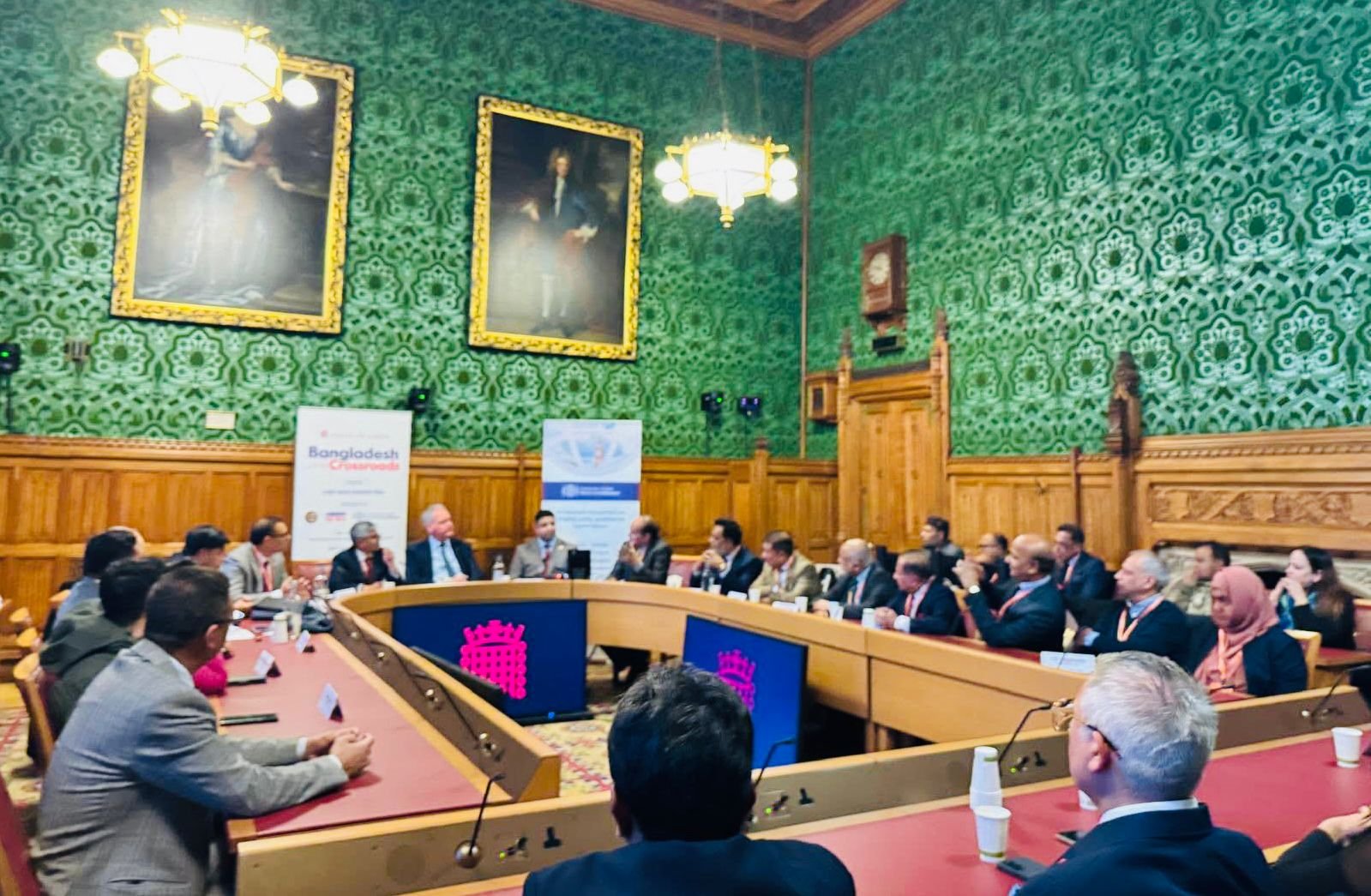
Robert John Blackman CBE MP, a senior British parliamentarian and Member of Parliament for Harrow East since 2010, attended and addressed the high-level seminar titled “Bangladesh at the Crossroads” held at the House of Lords. Mr Blackman currently serves as Chair of the 1922 Committee and Chair of the Backbench Business Committee; positions he has held since 2024.
The seminar took place in Committee Room 3 of the House of Lords and was hosted by Lord Rami Ranger. The event was jointly organised by Politika News, the Centre for Global Policy and Governance, and the Northampton British Bangladeshi Business Chamber.
The meeting was formally welcomed by Councillor Naz Islam of Northampton Town Hall and presided over by Lord Rami Ranger. A cross-party debate and interactive Q&A session followed, moderated by Tanvir Ahmed, Editor-in-Chief of Politika News. The keynote address was delivered by Barrister Sonjoy Kumar Roy, Co-Founder of the Centre for Global Policy and Governance.
Key Messages Emphasised by Bob Blackman CBE MP
- Bangladesh referendum risks creating an Islamic state
- Election credibility depends on participation, inclusivity, and public confidence
- Banning political parties undermines democracy
- Elections held without inclusivity cannot represent the Bangladeshi people
- Intimidation, coercion, or armed influence at polling stations is not democracy
- Minority persecution in Bangladesh is real, documented, and ongoing
- The UK government must not ignore Bangladesh’s human rights crisis
- Diaspora communities must engage MPs and demand accountability
Remarks by Bob Blackman CBE MP
Lord Rami Ranger is your host this afternoon. I have been to Bangladesh on several occasions. The United Kingdom has had a longstanding friendship with Bangladesh. When Bangladesh fought for independence in 1971, under Prime Minister Edward Heath, the UK supported Bangladesh’s independence, even when others were blocking it. Indeed, the founding father of democracy in Bangladesh, Sheikh Mujibur Rahman, made his first visit after independence to the UK, meeting Prime Minister Heath. That is the historical context of our relationship.
Since the coup took place and a caretaker leadership emerged, many of us were initially in two minds. There were, of course, serious concerns about demonstrations and the killing of students during Sheikh Hasina’s premiership. However, the fact that she was forced out, followed by tribunals meeting and sentencing her to death in her absence, and the targeting of other Awami League figures, is deeply concerning.
On my visits to Bangladesh, I have always sought to meet leaders of all political parties. We want to be friends with everyone, and we want to see Bangladesh on a stable and sound footing. My concern is that with elections scheduled next month, they cannot currently be described as free, fair, and inclusive. The Awami League may be unpopular with some, yet polling suggests at least 30 percent of the population still supports it.
Let me be clear: I do not support any political party in Bangladesh. But if you start banning political parties from standing in elections, you have a serious problem. On one of my previous visits, I told BNP leaders not to boycott elections, because if you do not stand, you cannot win. If you participate and believe cheating has occurred, that is the time to complain. Boycotts leave you without representation and do not help democracy. Unfortunately, boycotts have happened, and that is not helpful.
If, in this country, we banned a political party simply because we did not like them, that would be unacceptable. The same principle applies in Bangladesh. Elections conducted under these conditions will not be representative of the Bangladeshi people, and that will not improve the situation in any way.
There is also a push for a referendum ahead of elections. If people wish to pursue constitutional change through a referendum, that is a matter for the country. However, the direction of this proposed referendum is extremely serious. It would effectively create an Islamic state, which I do not believe the people of Bangladesh want. Worse still are reports of attempts to force people to vote in favour through intimidation, including armed individuals at polling stations. That is not democracy. If that happens, it would be disastrous for Bangladesh’s future.
Another concern is support from some quarters for closer alignment with Pakistan. Men, women, and children died for Bangladesh to be free from Pakistan. I do not believe the people of Bangladesh want reunification in any form, particularly with a country where military rule dominates and democracy is effectively dead.
I have been raising human rights concerns in Bangladesh for weeks and months in the House of Commons. Minority communities—Hindus, Christians, and minority Muslim sects—are being relentlessly targeted. People are being killed in the streets, places of worship are being burned, and homes are being ransacked. This is not about inclusivity; it is about exclusivity and the removal of minorities.
These are not fabricated stories or social media misinformation. I have been shown documented evidence, names, and details of people who have been killed and why. These are real murders. We must continue to call this out.
My advice to all of you is simple: contact your local MPs. We discuss foreign policy constantly, yet Bangladesh is often ignored. There has, in my view, been a lacklustre response from the Foreign, Commonwealth & Development Office. They appear content to let the caretaker leadership continue without sufficient scrutiny.
I urge you to engage MPs of all parties. Email them, visit their surgeries, and explain the problem. I will continue to speak out, even if only a small number of us do. A video released last week reached half a million views, showing that people care. Despite claims of fake news, the reality is that people are dying because of who they are, their religion, and their political affiliation. That is absolutely unacceptable.
It is a pleasure to open this conference on behalf of Lord Ranger. I regret that I must leave shortly due to another parliamentary commitment, but I wish you a productive and meaningful conference. Thank you.
Participants and Contributors
The seminar featured contributions and participation from Anwar Choudhury, former British High Commissioner to Bangladesh; Osama Khan, Vice-Chancellor of the University of South Wales; Nadira Naznin Rakhi, DPhil student at the University of Oxford and lecturer at the University of Dhaka; Shahagir Bakth Faruk MSc, Adviser Emeritus, British Bangladeshi Chamber of Commerce & Industry; Dr Zaki Rezwana Anwar, Mother and Child Health Specialist; Mitu Choudhury, Secretary General of the Bangladesh Caterers Association (UK); Bashir Ahmed BEM, former President of the British Bangladeshi Chamber of Commerce & Industry; Professor Dr Sanawar Choudhury, CEO of RCI Accountancy; Professor Dr Habib-e-Millat, President of the Global Centre for Democratic Governance; Aminul Haque, former diplomat and intelligence officer of Bangladesh; Md Razib Parvez, Founder of the Governance Policy Explore Centre; Haradhan Bhowmik, former President of the Sarbojanin Baba Lokenath Association (UK); Moinul Islam Monju, barrister and human rights lawyer; Michael Murphy, barrister and human rights lawyer; Ameena Tabassum, author and data professional; Harmuz Ali, President of the Bangladesh Welfare Association; Ansar Ahmed Ullah, journalist at The Daily Star; Shofa Miah, Director of Newham Voices; Md Zakir Hussain, Director of Community Careline Medway Ltd; Adity Roy, choreographer and dancer; and Syed Ali Ziru, barrister and human rights lawyer. Representatives from British Bangladeshi civil society were also present and shared their perspectives.