

The recent meeting at the UK’s House of Commons on Bangladesh, on 8 April 2025, brought memories of my long years of working to support people whose human rights had been violated.
Over four decades, I have met countless people who had been the targets of human rights abuses in the country. Whenever I have met the same people again, after many years, they have told me how my work on their behalf, and the subsequent action I had initiated at Amnesty International, had worked to save them from continued harassment, repression, and violation of their human rights.
My support did not and does not extend to just one group of people, or members of just one political party, or members of just one community. It has covered men, women, and children. It has covered individuals and groups, regardless of who they were and what political or community groupings they belonged to. It has covered members of all political parties, including Bangladesh Nationalist Party, Jamaat-e Islami, Awami League, and other political parties. It has covered Muslims, Hindus, Buddhists, Christians and other religious groupings. It has covered not just ordinary members of political parties but many of their senior leaders.
I have seen governments come and go. And I can clearly say that the only government who tried to stop my human rights work in Bangladesh was the government of Sheikh Hasina after her second assumption of power in one sided election.
Bangladesh High Commission in London issued visas for me and my team members who would be traveling with me, as had been the case in the time of previous governments. But a day later, they withdrew the visas, tearing of the visa stickers from our passports’ pages.
In my experience, Sheikh Hasina’s government has been the most repressive government in the most recent history of Bangladesh. I welcomed the collapse of her oppressive regime on 5 August 2024.
That however does not mean that other governments have been immune from wrongdoings. And this is exactly what I wish to emphasize today.
It is now just over 8 months since the victory of the student-led protests of July-August 2024. During these months, the country has witnessed an unprecedented degree of openness and transparency. Political prisoners have been released. People held at the notorious House of Mirrors have returned to their families. Freedom of expression has been reinstated. The people’s trust in the democratic process has largely been restored.
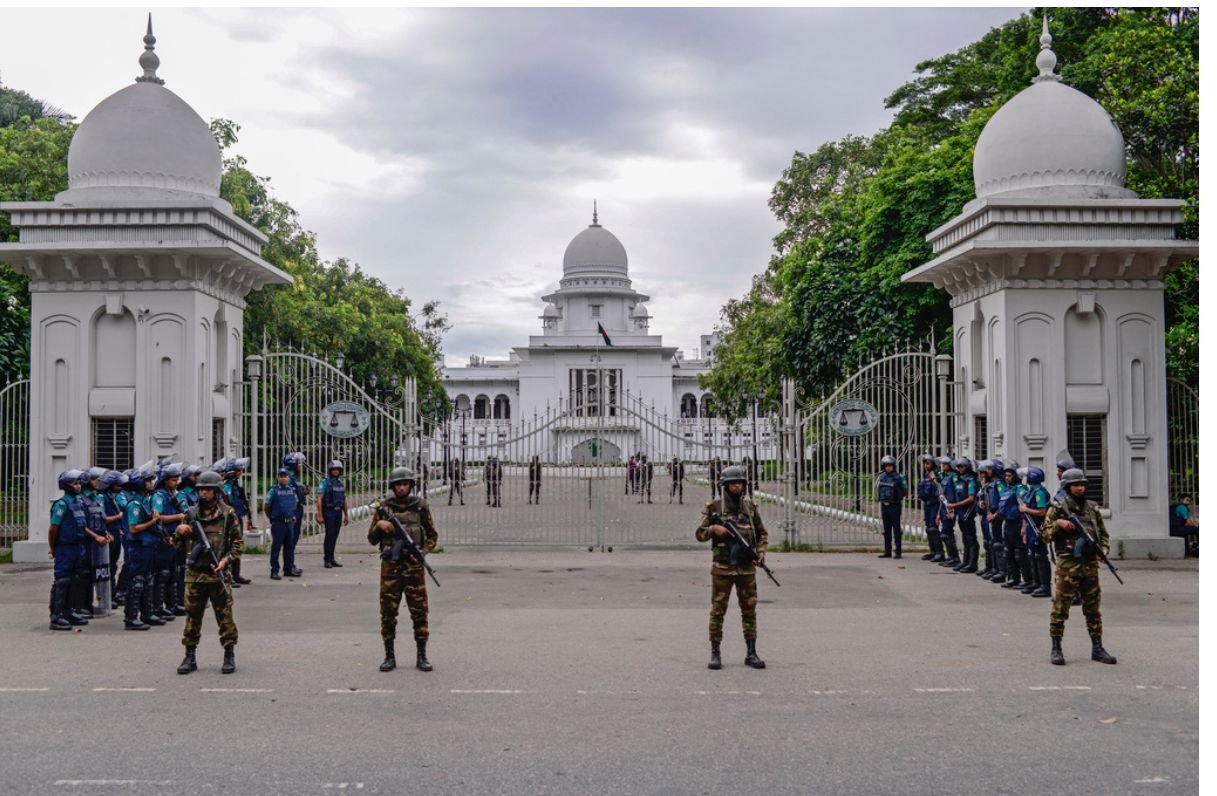
But there are problems, which have not been resolved. The rule of law remains subjugated to apparant political influence. It was our hope that heroic efforts would be taken to remove political influence from judicial practices. Sadly, this remains an unfulfilled hope.
One example of deepening cracks in judicial processes is the situation of Shahriar Kabir. Mr Kabir was detained after the July-August uprising, in what appears to be fabricated charges. His continued detention, and his treatment while in detention, raise concern about impartiality of the judicial processes in his case.
His case has been locked in the trial court, denying him the right to challenge the legitimacy of his detention before the High Court. There is concern that political influence may be preventing him from exercising his legitimate right to seek release on bail.
Mr Kabir has for decades been vocal about his opinions and views within the boundaries of freedom of expression. He was previously detained in November 2001 for writing articles, giving interviews and taking video footage of Hindu victims subjected to attacks and other human rights violations. At Amnesty International, we declared him a prisoner of conscience. He was released in January 2002.
Now Mr Kabir is in his seventies and while in detention he has had two heart attacks, but the reports I have seen indicate that he did not receive, against customary practice, the medical attention that he needed. He was also subjected to mob violence during a court hearing, with no indication of whether the attack had been investigated by the authorities.
This is not an isolated case, and there are many such cases.
When judicial processes do not follow expected customary practice, there is a strong likelihood that political pressure may be at work.
I am on record to have called for the investigation and trial of the former Prime Minister and senior Awami League leaders for engaging in what amounts to crimes against humanity.
I am, however, seriously concerned that the judicial direction the country has pursued in the past eight months has created new cases of human rights violations. Of these, the case of Shahriar Kabir is only one example.
There is an urgent need for such cases to be given close attention. The goals of the movement that unseated Sheikh Hasina’s repressive regime was to return the society to a better state for everyone. It was to unite the country, rather than pursuing the same divisive techniques used by the previous government.
The rule of law is inevitably the first and foremost that needs to be established. Within that judicial processes must be freed from political influence. They must be aligned with their core, which feeds from three fundamental conditions: independence from political influence, impartiality, and competence.
This is not a task to be left only to the Interim Government. All political parties functioning in Bangladesh could demonstrate their ability to unite the country by giving visible support to efforts aiming at establishing credible judicial practices capable of delivering independent, impartial and competent justice to anyone in the country.