

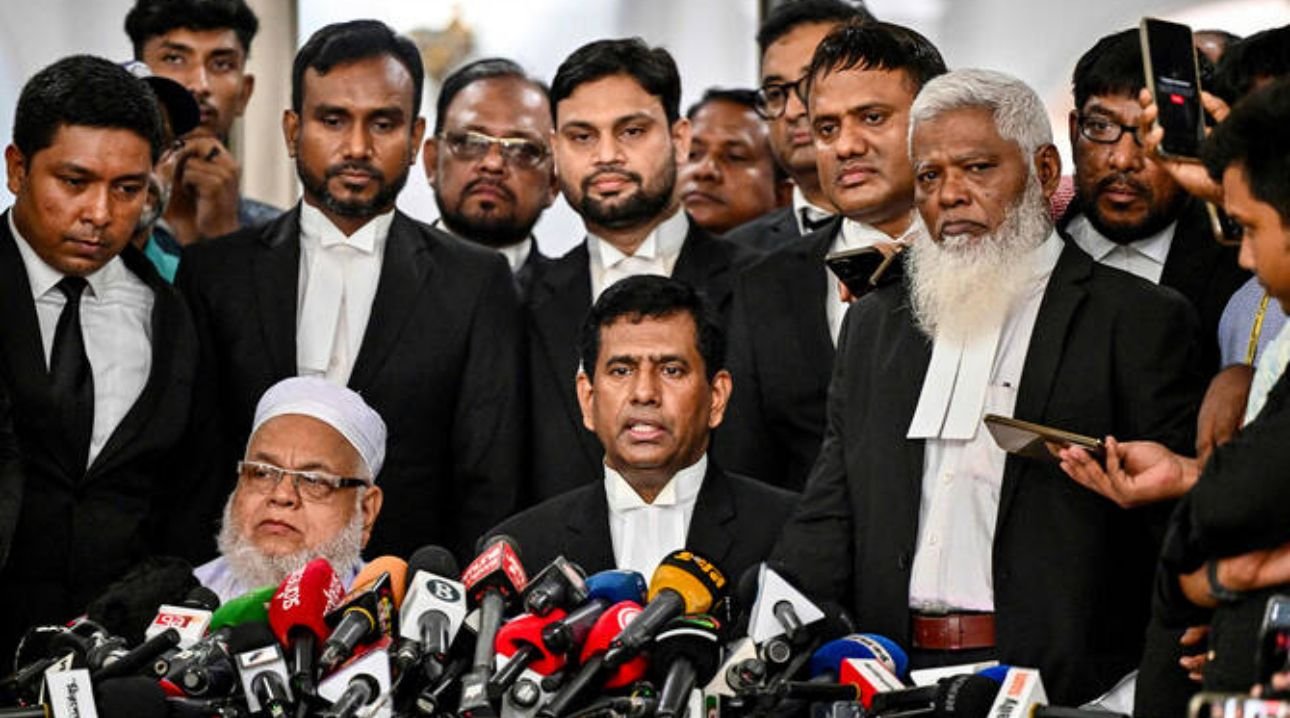
In 2011 I was instructed as lead trial counsel for several defendants charged by the Bangladesh International Crimes Tribunal with genocide allegedly committed during the 1971 Liberation War. The ICT was created by legislation back in 1973, but for 37 years it remained dormant.
When Sheikh Hasina won the 2009 election on a promise of seeking revenge against those the Awami League saw as responsible for the genocide, she immediately activated the ICT - not, as it turned out, as a platform for open justice, but as a tool of political oppression.
I visited Dhaka once, in early 2011. I was not allowed back. The government didn’t want any English lawyers highlighting the draconian powers of the ICT which more closely resembled Stalin’s show trials of the 1930s than anything we know as fair trial. I remained at home after that, advising the local defence teams, who continued bravely in the face of continued intimidation. Within about 2 years, 5 of my 6 clients had been hanged.
Around this time I wrote an article in the English Criminal Bar’s periodical, Counsel Magazine. Its title was ‘Bangladesh: Reconciliation or Revenge’. In it I assessed the ICT’s grave shortcomings, its impact on international law and in particular its political and social impact on Bangladesh. I argued that by deploying this frightening tribunal, dedicated to the elimination of political enemies without anything resembling due process, Bangladesh had wasted an opportunity to heal.
During that time Hasina, backed by militia groups, strengthened her hold on the Bangladeshi people. Opponents were imprisoned or went into hiding. I recall her speaking at the UN in New York in 2012, bewildered as to how the international community seemed ignorant as to what was going on. I spent a lot of time in those days talking to government representatives in the UK, the US, in the EU: few of them had any idea about Hasina’s cruel dictatorship.
But as is so often the case, hubris led to nemesis, and Hasina’s downfall last year. This should have been good news. Many of us looking on saw this as a golden, once in a generation opportunity to break the cycle of revenge. Now was the chance – and can still be the chance – for reconciliation.
But instead, what did Professor Yunus’s interim government do? They dusted off the ICT once more and turned its sights on Hasina herself and other Awami League leaders. If anyone seriously claims this is not a politically motivated trial let them examine the tribunal’s continued failure to adhere to modern standards and its continued use of the death penalty. It was an opportunity lost: the government could have led by example by announcing its intention to break with the past by abolishing the ICT, and by trying Hasina in a domestic court under domestic law. Unfortunately it seems the idea of turning Hasina’s precious tribunal on herself was too tempting. We call it victor’s justice.
But that hasn’t brought justice to the Bangladeshi people: sectarian violence, damage to religious sites, the ban on the Awami League are indications that rather than drawing a line in history, the 2024 uprising is simply another turn in the vicious cycle, with the prospect of what would effectively be another single-party government after next February’s election.
Reality is simple: you can’t have a democracy without open justice, and without open politics. A government that achieves power by silencing its opposition, afraid of dissenting voices is a weak government, which will only get weaker.
Silence the dissent, no matter how unpopular it is amongst moderate Bangladeshi people, and the dissent goes underground. It becomes more widespread. The more widespread the dissent, the more unstable and violent a nation becomes. The more unstable the nation the less governments and business outside Bangladesh want to invest: investment has fallen dramatically. Less investment kills growth. Collapsed growth creates poverty; poverty increases dissent and the cycle spirals down until the next crisis tears the country apart.
My first job as an international lawyer was at a tribunal in Sierra Leone in 2004 set up to try the surviving rebel leaders from the brutal civil war. I was there for 4 years. When I arrived I stayed in a hotel originally owned by a defunct British airline. It was now owned and run by a Chinese company that treated the local staff very badly. At the time Sierra Leone was just 2 years out of the war; it was bottom on the WHO’s register of developing nations. The country used to be the 4th richest in Africa due to its diamonds. But in 2004 Sierra Leone was a broken country.
Within 2 years the Chinese had built a huge embassy in the centre of the capital, Freetown. It was around that time that a treasure trove of precious metals were discovered in the country and offshore. By the time I left for the last time in 2009 Chinese belt and road projects had sprung up all over the land. It was painful to see a non-benevolent country taking such rich pickings so easily.
Look at Bangladesh now: not a million miles from China. Politically unstable. Brimming with natural resources: abundant natural gas, untapped coal reserves, mineral sands, and a vast cotton industry. Now look at Vietnam, look at Cambodia: tiger economies, yet both with more recent tragic histories. Bangladesh should be stronger than both of them put together. Yet still it remains outside the largest and most powerful trading bloc in the region, the Association of South East Asian Nations. How could this be allowed to happen?
How can Bangladesh look confidently to a future without stealthy Chinese economic colonialism? Right now, it can’t. With open politics, open justice and open democracy it can. But there is something else that I believe is vital to provide a stable future.
I didn’t just learn about Chinese expansionism in Sierra Leone. I learned how their Truth and Reconciliation Commission touched the entire country. I learned how the TRC brought people on opposing sides together all over the land. People with traumatic memories reconciling with their oppressors. This was reconciliation overpowering revenge. And it worked. Just as it worked too in South Africa, just as it worked in Northern Ireland. With the will, it can work in Bangladesh and bring peace and prosperity to a nation at ease with itself.
I believe the international community has a vital part to play in guiding Bangladesh to the comity of nations: from the US, to the Commonwealth of Nations, to the ASEAN bloc. Strategically and economically Bangladesh should, and I believe could become a regional powerhouse were it to embrace outside assistance from benevolent countries whose investment in trade and infrastructure could secure the nation’s future, protecting the nation from colonialism by stealth, and its people from autocracy and corruption. There will never be a better opportunity than this.