
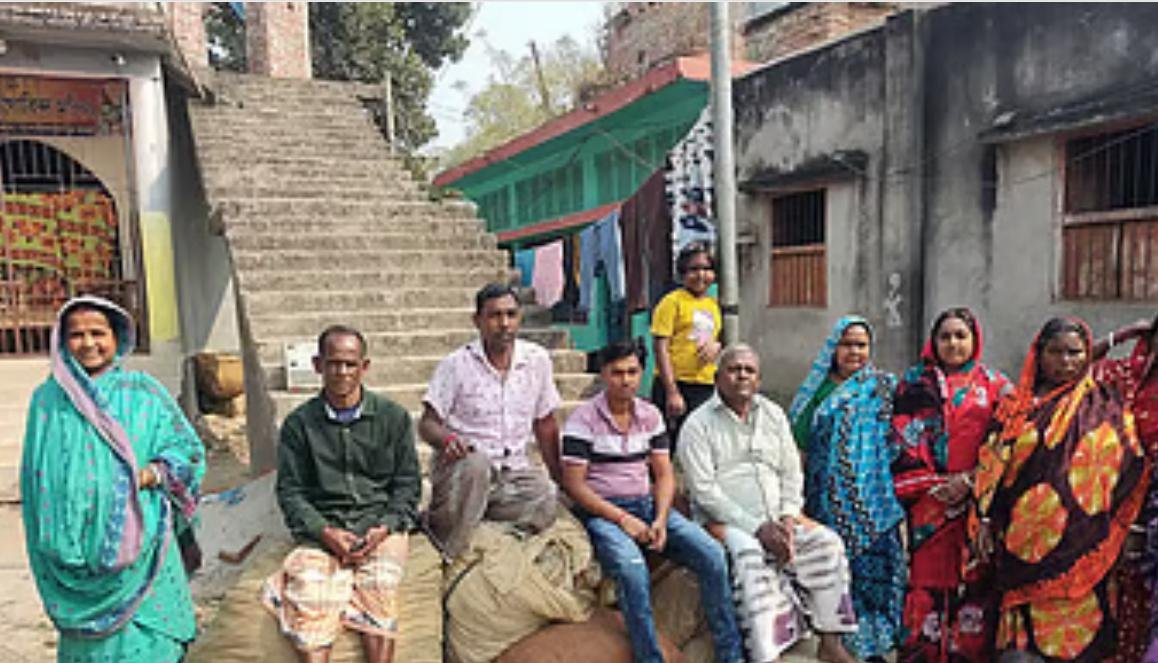
On one side lies Chapainawabganj town and on the other Bargharia, separated by the Mahananda River and connected by the Bir Sreshtha Captain Mohiuddin Jahangir Bridge, popularly known as the Mahananda Bridge. At the Bargharia end of the bridge, Notun Bazar village has grown along the riverbank, where around 140 to 150 families currently live.
Among them, approximately 25 families are potters, while the rest depend mainly on fishing for their livelihood. Except for one or two households, nearly all residents belong to marginalised, impoverished Hindu families. As the national election approaches, the villagers say they have no political demands — their only wish is to live safely and peacefully.
Residents said leaders and activists from BNP and Jamaat-e-Islami have recently visited the area, assuring villagers that there is nothing to fear and promising support. However, these assurances have done little to reduce the prevailing fear, anxiety and uncertainty among the community.
Several villagers, including Bakul Halder (56), Furti Halder (67), Sanjay Halder (43), Subrata Halder (43) and Lalon Halder (51), shared their concerns while sitting on folded fishing nets laid out in an open space in front of the village temple. Under the mild winter sun, they discussed the election and their everyday struggles.
Bakul Halder said they neither expect much nor believe that any assistance will reach them. “We want nothing except to live safely,” he said, adding that no one would arrange food or clothing for them and that survival depends on working in others’ homes. Furti Halder echoed the same sentiment, with others in agreement.
The villagers also referred to recent incidents across the country, including the burning to death of Dipu Das and attacks on Hindu homes in various areas. Some recalled the memories of 1971, when villagers had fled to India during the Liberation War. A deep sense of anguish was evident as they spoke about the uncertainty over when the country would see a stable and secure environment.
Residents said neighbouring villages in Bargharia union — including Halderpara, Palpara and Mondolpara — are also predominantly Hindu, and people there share similar fears and concerns.
According to Bakul Halder, the political situation has changed over time. “Earlier, being Hindu meant being a ‘boat voter’,” he said, referring to the Awami League’s election symbol. “Now the boat symbol is no longer there, and both sides are trying to pull voters towards them.” He added that Awami League supporters and Hindu voters have now become a factor in local politics, leading to the current political tug-of-war.
Village resident Mina Halder (58) said her husband, Kanan Halder (65), has been bedridden due to illness. Although Tk 20,000 saved for his treatment has already been spent, he has not recovered. The family includes their speech-impaired daughter Mala (35) and son Dukhu Halder (24).
Dukhu is the sole earner of the family. He works as a kamla (daily wage labourer), pulling nets in ponds owned by fish farmers, and earns some money in the afternoons by ferrying people across the Mahananda River on a small dinghy. He said he used to fish in the river with his father during childhood, but fish stocks have sharply declined and fishing alone can no longer sustain any household.
Anxiety is particularly high among the women of the village. Deepali Halder, Laboni Halder, Rekha Halder, Sumati Halder and several others said women feel the most vulnerable during election periods, especially regarding security.
Source: Prothom Alo English
Published: 02 February 2026, 10:54
Reporter: Staff Correspondent, Chapainawabganj