

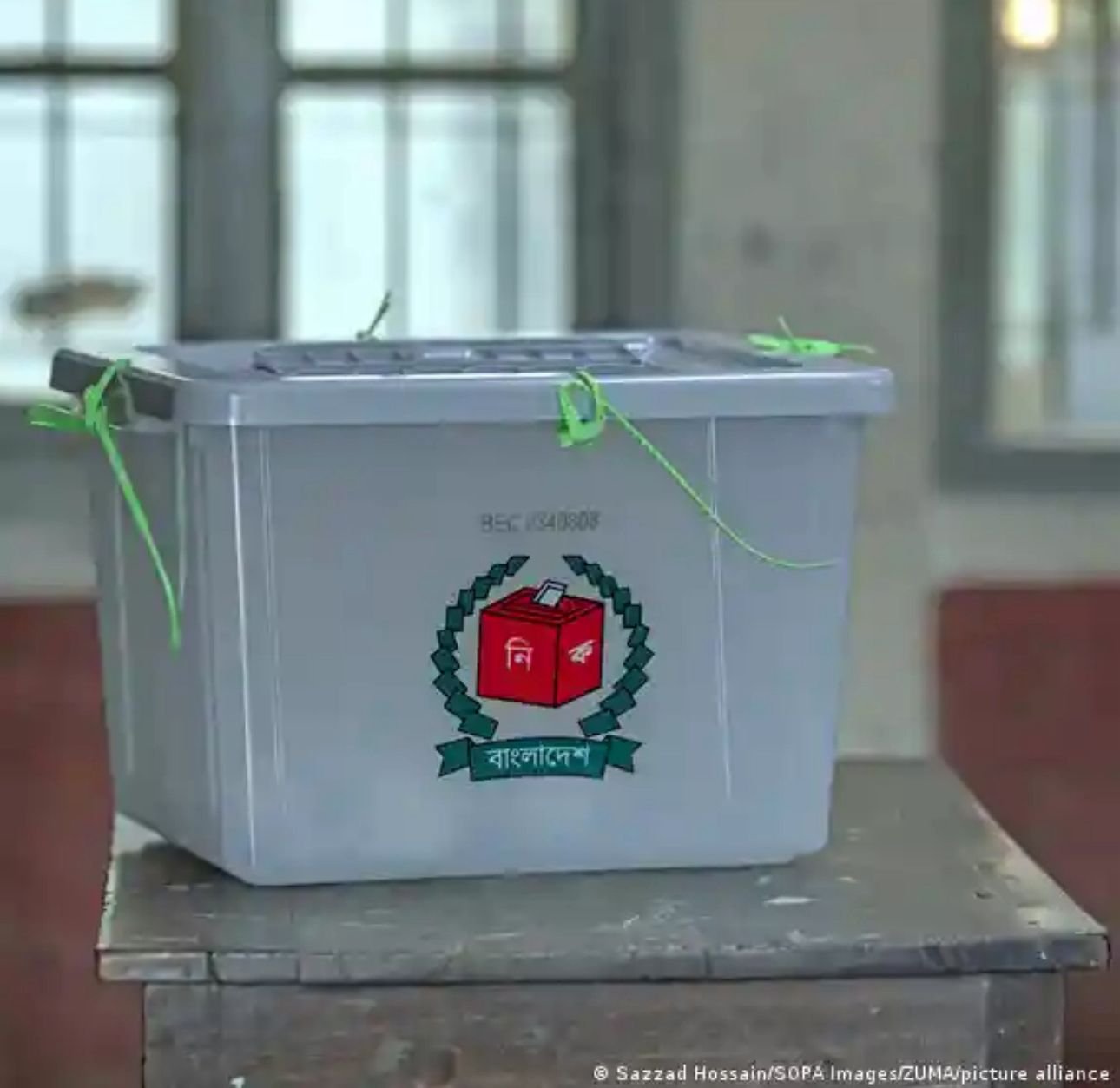
As Bangladesh prepares to hold its first election since the overthrow of former Prime Minister Sheikh Hasina and her Awami League government in 2024, neighbouring India, Pakistan, and China are watching closely.
The country is currently governed by an interim administration led by Nobel laureate Muhammad Yunus. The two principal parties competing for power in this month’s polls are the Bangladesh Nationalist Party (BNP) and Jamaat-e-Islami (JIB), both of which began campaigning in late January.
The Awami League—historically one of Bangladesh’s dominant political forces and a close ally of India—has been barred from contesting the election due to its role in the violent crackdown on student-led protests in 2024. Former prime minister Hasina, now 78 and living in exile in India, was found guilty of authorising the use of lethal force against protesters, during which at least 1,400 people were killed.
In November last year, Bangladesh’s International Crimes Tribunal tried Hasina in absentia and sentenced her to death. India has so far refused to extradite her.
Hasina has denounced the upcoming election, telling the Associated Press last month that “a government born of exclusion cannot unite a divided nation.”
Since her ousting, analysts say Bangladesh’s geopolitical posture has undergone a significant shift.
“Bilateral relations with India have reached a historic low, while ties with Pakistan have warmed considerably. At the same time, strategic engagement with China has deepened,” said Khandakar Tahmid Rejwan, a lecturer in global studies and governance at Independent University, Bangladesh.
He noted that Hasina’s 15-year rule was defined by three key foreign policy pillars: close and comprehensive relations with India; diplomatic distance from Pakistan; and a carefully calibrated partnership with China focused on defence, trade, and infrastructure.
“That predictable alignment has now been reversed with respect to India and Pakistan, and recalibrated in relation to China,” Rejwan said.
So how do India, Pakistan, and China view the upcoming election—and does the outcome matter to them?
India-Bangladesh relations
Until Hasina’s fall, India regarded Bangladesh as a critical strategic partner in South Asia. India is Bangladesh’s largest Asian trading partner, exporting goods worth $11.1bn between April 2023 and March 2024, while importing $1.8bn worth of Bangladeshi products.
Since Hasina fled to India, however, relations have deteriorated sharply. Both countries have imposed trade restrictions amid rising political tensions.
Although India supported Bangladesh’s independence from Pakistan in 1971, bilateral relations have fluctuated over the decades depending on which party governed in Dhaka. Hasina, who served as prime minister from 1996 to 2001 and again from 2009 to 2024, maintained particularly close ties with New Delhi.
In 2020, Indian Prime Minister Narendra Modi described bilateral ties as a “golden chapter.” Yet Hasina’s opponents frequently accused her of being overly accommodating to Indian interests.
Anti-India sentiment intensified following her ouster and India’s refusal to extradite her. Relations worsened further after the killing of Osman Hadi, a prominent anti-India protest leader, which sparked demonstrations targeting Indian interests in Bangladesh.
India has also raised concerns about the treatment of Bangladesh’s Hindu minority under the interim government. Diplomatic friction has spilled into sports as well: after Bangladesh requested that its T20 World Cup matches in India be relocated to Sri Lanka, the ICC expelled Bangladesh from the tournament. Pakistan later backed Bangladesh, refusing to play India in solidarity.
“India suffered a major strategic setback with Hasina’s removal,” said Michael Kugelman, senior fellow for South Asia at the Atlantic Council. “New Delhi has been uneasy with an interim government it views as influenced by Jamaat and other religious actors.”
Despite tensions, Modi and Yunus met last year on the sidelines of a BIMSTEC summit, where India reiterated its support for a “democratic, stable, peaceful, and inclusive Bangladesh.”
How India views the election
India’s stakes are high.
“New Delhi wants a government in Dhaka that is willing to engage constructively and is not influenced by actors it perceives as security threats,” Kugelman said.
While India would be most comfortable with a BNP-led government, it has also reached out to Jamaat leaders, reflecting uncertainty about the election outcome.
“India recognises that the Awami League is unlikely to return to power in the near future,” Kugelman said. “It would accept a BNP government and work to repair the relationship.”
Pakistan-Bangladesh relations
Since Hasina’s removal, Pakistan has moved quickly to rebuild ties with Dhaka. Pakistani Prime Minister Shehbaz Sharif met Yunus twice in 2024, and the two countries have resumed direct trade and flights for the first time in more than a decade. Defence and military dialogues have also restarted.
Analysts say Pakistan sees an opportunity to expand influence by exploiting anti-India sentiment and Islamist political momentum in Bangladesh.
“Pakistan wants to heighten India’s eastern security concerns by drawing closer to Dhaka,” Rejwan said, adding that Islamabad has also promoted the idea of a Bangladesh-China-Pakistan trilateral alignment.
How Pakistan views the election
Pakistan would welcome either a BNP or Jamaat victory, though a Jamaat-led government would be its preferred outcome, Kugelman said.
A BNP government, however, would likely maintain balanced ties rather than align strongly with Islamabad. “BNP’s policy is Bangladesh first,” Rejwan noted, “which means strategic hedging rather than dependence on any single external power.”
China-Bangladesh relations
China’s influence in Bangladesh has expanded steadily, regardless of which party is in power. Under both Hasina and Yunus, Beijing has invested heavily in infrastructure, defence cooperation, and development projects. The interim government has secured more than $2.1bn in Chinese investments and loans.
China has also pledged support for managing the Rohingya refugee crisis and has discussed potential defence deals, including fighter jet purchases.
“Beijing adjusted quickly to the new political reality,” Rejwan said. “Sino-Bangladesh relations were strong under Hasina and are even stronger under the interim administration.”
How China views the election
China has actively engaged all major Bangladeshi political parties ahead of the polls but is not seen as favouring any single outcome.
“For Beijing, political stability is paramount,” Kugelman said. “It wants to protect its investments and limit external—particularly US—influence.”
Rejwan added that China prefers inclusive engagement with all political actors and is prepared to work with whichever party forms the next government.
Source: Al Jazeera
The views and analysis presented here are drawn from Al Jazeera reporting.