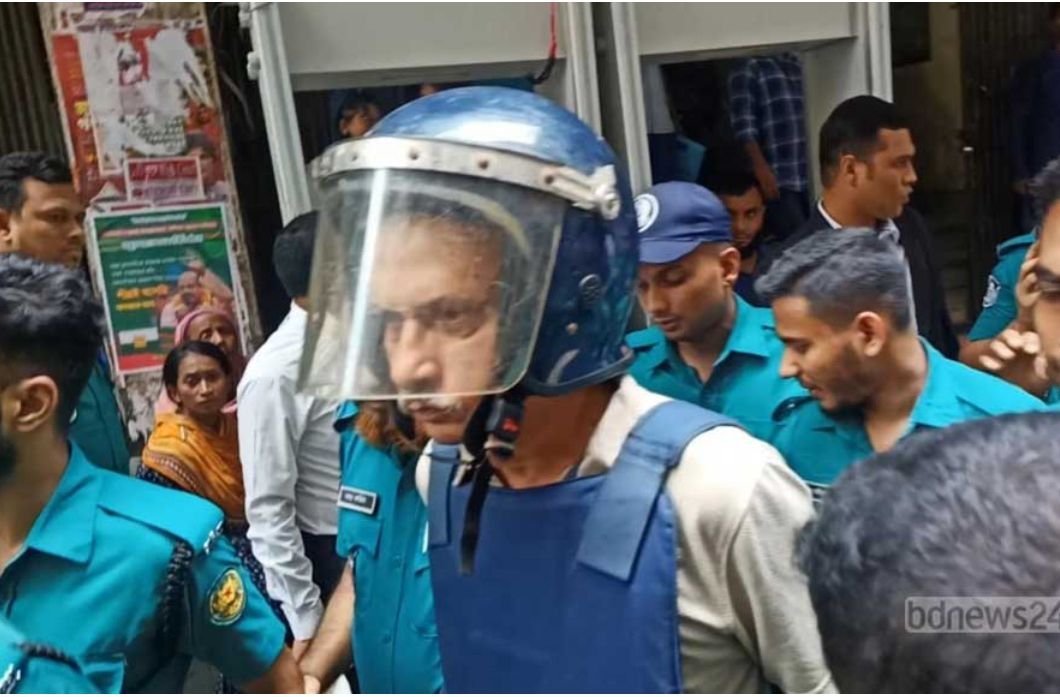
Mr. Mozammel Haque is 61 years old. For more than sixteen months, he has woken each morning not to the newsroom he once led, but to the iron bars of a prison cell. A respected journalist and one of Bangladesh’s most recognised media professionals, he now endures prolonged incarceration—cut off from his family, his profession, and critically, from the medical care that may determine whether he lives or dies.
Before his arrest on 16 September 2024, Mr. Haque served as Editor-in-Chief and Managing Director of Ekattor Television, a privately owned news channel and one of the country’s leading broadcasters. Throughout a long professional career, he neither held a government position nor occupied any official role within a political party. His work was rooted in journalism—asking questions, holding microphones, telling stories—never wielding power.
Today, his family lives under relentless emotional and financial strain. Their anguish is deepened by a cruel reality: Mr. Haque is a cancer patient suffering from multiple life-threatening medical conditions, now confined in an environment wholly unequipped to preserve his health, dignity, or life.
An Arrest in the Dark
In the early hours of 16 September 2024, Mr. Haque was detained. The arrest came without warning, linked to a murder case allegedly connected to the July–August 2024 mass uprising—a case neither he nor his family had ever heard of. By the following day, he was brought before a Dhaka court. There, in open court, he was subjected to verbal harassment, an experience that stripped him not only of personal dignity but also cast a shadow over the sanctity of judicial decorum.
A seven-day police remand was granted. Afterward, he was transferred to Dhaka Central Jail in Keraniganj, where his prolonged detention continues.
The arrest rests on a First Information Report (FIR) that names more than 200 individuals. Its allegations are broad, vague, and generalized, yet among the charges is Section 302 of the Bangladesh Penal Code—murder—a charge that carries the ultimate punishments of death or life imprisonment. Despite the severity of these accusations, no credible or individualized evidence has ever been presented to link Mr. Haque to the alleged crime.
What followed compounded the injustice. After his initial arrest, Mr. Haque was implicated in multiple additional murder cases. Each case bears the same troubling features: sweeping allegations, an absence of evidence, and no demonstrable connection to his actions. These repeated filings have served one purpose—to prolong pre-trial detention—while multiplying legal peril and inflicting crushing emotional and financial hardship upon his family.
A Silenced Press, A Chilling Pattern
Mr. Haque’s case does not stand alone. As of May 2025, at least 266 journalists across Bangladesh have been charged under similarly unsubstantiated cases. This reflects a broader and deeply troubling pattern: systematic intimidation of independent media, enforced not through overt censorship alone, but through legal harassment, prolonged detention, and financial ruin. The message to journalists is clear—and chilling.
A Body Failing Behind Bars
Beyond the courtroom, another crisis unfolds quietly and relentlessly inside Mr. Haque’s body.
In late 2023, he was diagnosed with prostate cancer and underwent a radical prostatectomy—an invasive, life-altering surgery. Even after such treatment, the danger does not pass. The early years following surgery are critical; the risk of biochemical recurrence remains high, and survival depends on strict, regular cancer surveillance.
Since his detention, Mr. Haque has been entirely deprived of this essential follow-up care. A scheduled cancer screening on 8 November 2024 was missed. The prison healthcare system lacks the capacity for specialised oncology monitoring. Any delay in detecting recurrence could allow the cancer to metastasise, spread systemically, and become terminal. Continued detention under these conditions effectively denies him his fundamental right to health—and to life itself.
This danger is further intensified by his uncontrolled diabetes, hypertension, and elevated triglyceride levels. These conditions are not isolated; they interact, worsen cancer outcomes, and demand constant monitoring and precise medical management. Overcrowded, under-resourced prison medical facilities are categorically incapable of managing such complex, intersecting health needs, particularly for an elderly cancer survivor.
A Question of Conscience
Taken together—the absence of substantiated evidence, the repeated filing of generalized and overlapping murder charges, and the immediate threat to Mr. Haque’s life—raise grave and unavoidable concerns. His continued detention risks amounting to arbitrary deprivation of liberty and exposes him to irreparable harm.
This is no longer merely a legal matter. It is a humanitarian one.
Immediate measures to secure Mr. Mozammel Haque’s release on medical and humanitarian grounds are essential—not as an act of charity, but as a duty to uphold life, dignity, and the fundamental principles of human rights. Each passing day in custody is not just another day lost; it is a step closer to irreversible tragedy.
History will remember not only what was done to this journalist—but who chose to remain silent, and who chose to act.
CGPG Report/ Dhaka
05 February 2026