
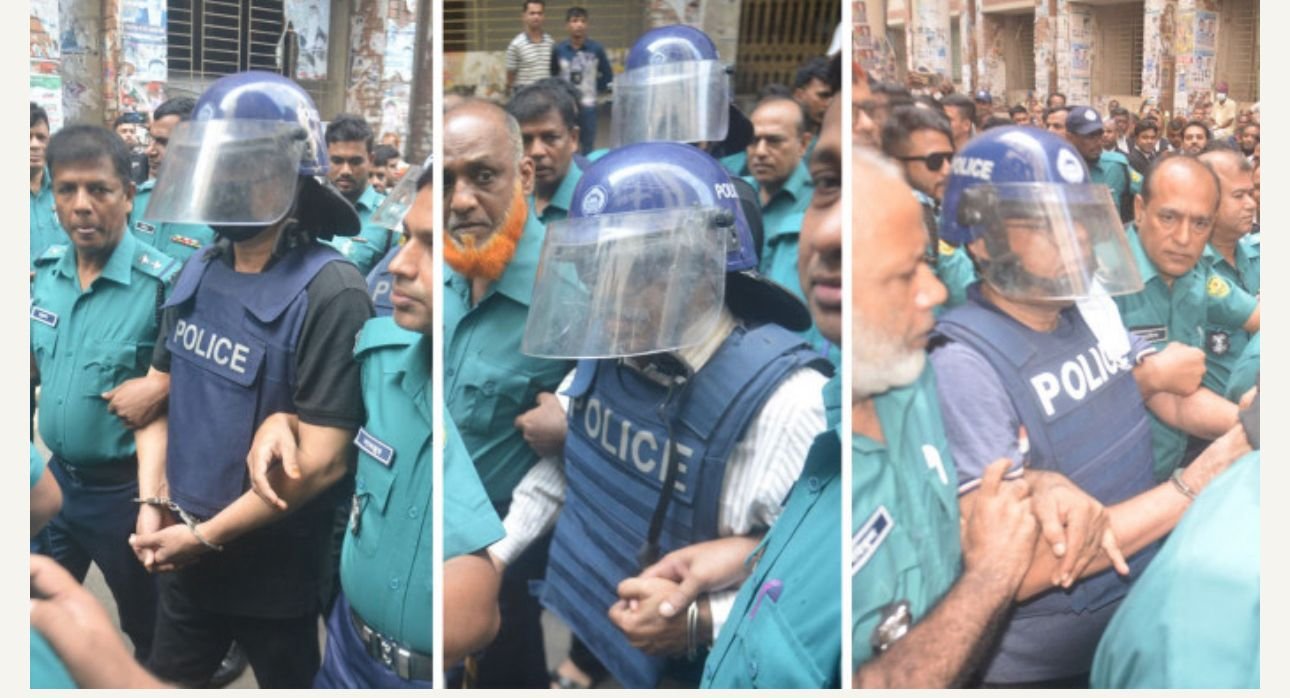
Shyamal Dutta is not a fugitive. He is not an accused caught at a crime scene. He is a journalist—one who has spent his life documenting events, not committing them. Yet since September 2024, this senior Bangladeshi journalist and Editor of Bhorer Kagoj has lived behind prison walls, deprived of liberty, dignity, and life-sustaining medical care, under accusations unsupported by evidence.
His arrest is tied to a murder case arising from unrest in Dhaka on 5 August 2024, in which a man named Fazlu lost his life. The pain of that death is undeniable. But justice demands truth, not convenience. The complaint in this case names 165 individuals and an additional 150 to 200 unidentified persons, asserting collective responsibility based not on actions, but on perceived political affiliation. The case file fails to identify the shooters. It offers no eyewitness testimony, no forensic link, no evidence placing Shyamal Dutta at the scene. At the time of the incident, he was not even in Dhaka—he was in another state, with his family, far from the violence that later engulfed the capital.
A Climate of Fear
The days following the political transition were marked by chaos and terror for Bangladesh’s media community. Newsrooms were attacked. Journalists were threatened, hunted, and silenced. Shyamal Dutta’s workplace was vandalized. He received multiple death threats—warnings not whispered, but screamed into the void.
On 15 September 2024, in Mymensingh, that fear became physical reality. Shyamal Dutta and several other journalists were abducted by unidentified assailants, beaten, and robbed. When police finally intervened, the victims expected protection. Instead, they were detained—arrested under Section 54 of the Criminal Procedure Code, a provision long criticised for enabling arbitrary detention.
When attempts to justify that detention failed, police searched existing case records. Only then was Shyamal Dutta shown arrested in the earlier murder case—an allegation disconnected from both evidence and logic.
Court proceedings that followed offered no relief. Rather than careful examination of facts, the hearings were marked by hostility and unrelated accusations. No evidence was presented demonstrating his involvement in the alleged crime. Yet remand was granted. He was transferred to prison, where he remains today. Since then, additional murder and attempted murder cases have been filed—none properly investigated, none brought to trial. Bail has been denied repeatedly, prolonging incarceration without adjudication.
A Body Breaking in Captivity
Behind the legal cruelty lies a quieter, more terrifying reality: Shyamal Dutta’s body is failing.
For years, he has suffered from obstructive sleep apnea, a serious condition that requires nightly use of a CPAP machine simply to breathe safely during sleep. For months after his incarceration, he was denied access to this device altogether. Though later permitted, the machine requires regular medical calibration—care that has not been provided. In its current state, it is largely ineffective.
He also suffers from coronary heart disease, including arterial blockages that demand constant cardiological monitoring. No such evaluations have taken place during his detention. The relentless stress of imprisonment—combined with harsh conditions, uncertainty, and fear—has worsened his diabetes, elevated his blood pressure, and eroded his overall health.
Each night in custody carries risk. Each untreated condition compounds another. The danger he faces is not abstract or distant—it is immediate and potentially fatal.
A Family Punished Without Trial
The suffering does not end with him. Shortly after his arrest, his family’s bank accounts were frozen without notice, plunging them into sudden financial hardship. His legal representatives have faced intimidation. The environment surrounding the case is defined not by transparency or due process, but by fear.
This is punishment without conviction. A sentence imposed before a verdict.
A Question That Cannot Be Ignored
The case against Shyamal Dutta rests on mass accusations without individualized evidence, arbitrary arrest, prolonged detention without trial, and denial of essential medical care. His continued imprisonment—despite the absence of credible proof and the serious deterioration of his health—raises urgent humanitarian and legal concerns.
Justice is not measured by how many names are written into a case file. It is measured by truth, evidence, and humanity.
As days turn into months, and months into years, the question grows heavier: how long can a society look away while a journalist is slowly broken behind bars—not for what he did, but for who he is?
History will remember this moment. And it will ask who chose silence, and who chose compassion.