
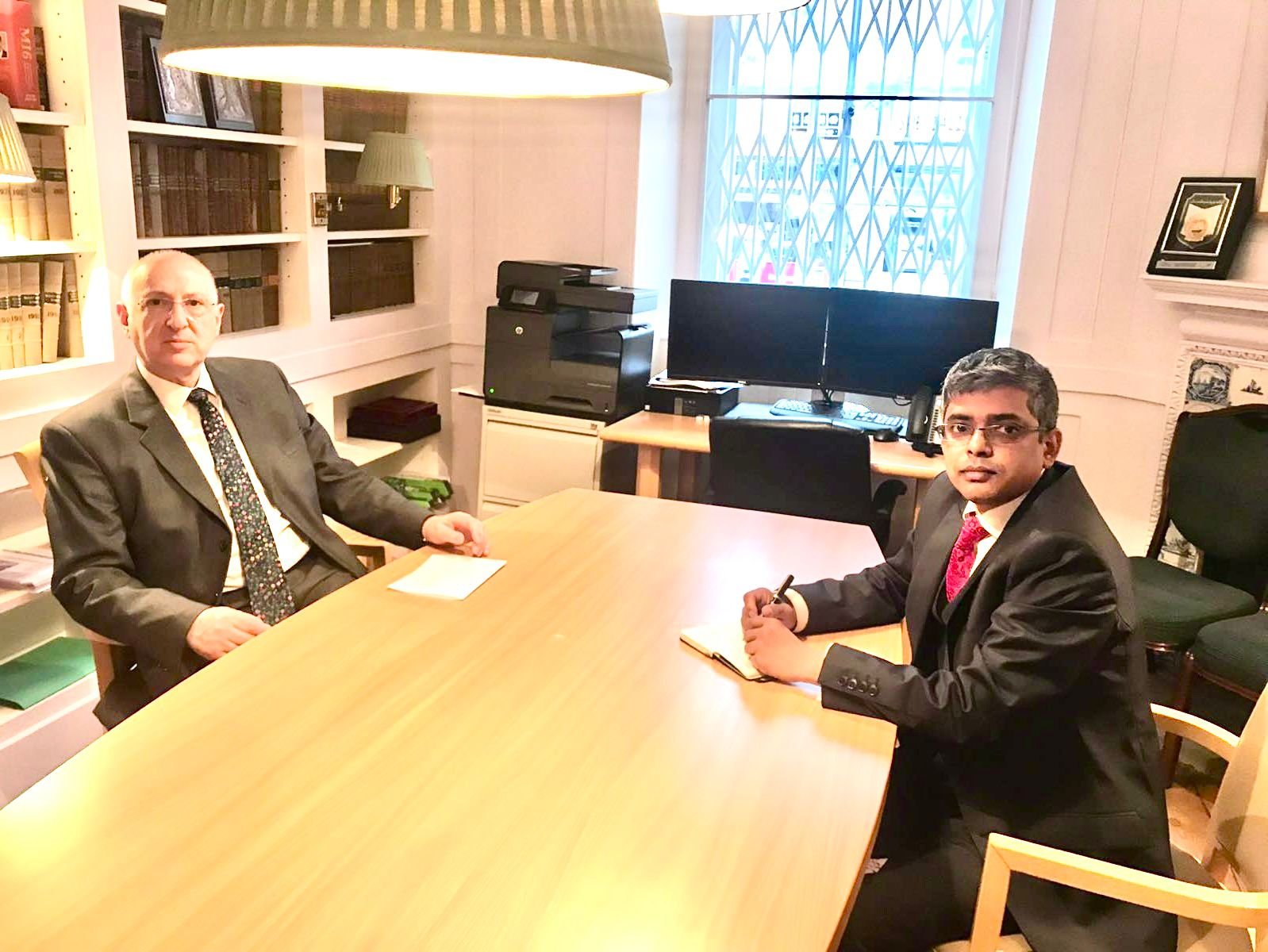
Senior British lawmaker Lord Alex Carlile has issued a stark warning about Bangladesh’s political and judicial direction, calling for urgent restoration of the rule of law, free and fair elections, and political plurality, during an exclusive interview with Politika News at the House of Lords.
Speaking on the sidelines of a parliamentary seminar on Bangladesh, Lord Carlile said the discussion was essential for British parliamentarians, many of whom maintain long-standing support for Bangladesh and its democratic aspirations.
“I think it’s very important for British parliamentarians to discuss what is going on in Bangladesh. Many of us here feel a great deal of support for Bangladesh and particularly for the notion of free and fair elections and Bangladesh making its way back into the friendliness of nations — the community of nations, as we call it.”
However, he stressed that reintegration into the international community must be achieved through lawful means.
“It has to be done properly, and we’re very concerned about the nature of the trials that are taking place at the moment, and about the facilities being given to defendants in these trials. However guilty some of them may be, they’re entitled to fair trials.”
Lord Carlile expressed hope that Bangladesh would embark on a process of reconciliation and truth, allowing all legitimate political parties to participate in elections.
“We hope that a process will be started which is one of reconciliation and truth, and that when the elections take place, all proper political parties can participate, and the world at large will look upon Bangladesh as a nation that is welcomed back into the family of nations — which it is not at the moment. At the moment, it’s regarded as an outlier.”
Responding to a question about reports that Sheikh Hasina had been given a death sentence by Bangladesh’s International Crimes Tribunal, Lord Carlile was unequivocal in his legal assessment.
“Well, I’m a lawyer, right? I’m a British King’s Counsel, and my reaction is that the process of the trial was not a proper, fair trial. She was not entitled to choose her own counsel.”
He cited a recent incident in the same court as deeply troubling.
“Indeed, in another case yesterday in the same court, there was a shocking exchange between prosecuting and defence counsel in which prosecuting counsel, according to reports — if they’re correct — threatened defence counsel that she might be put on trial. That is not compliant with the rule of law.”
Lord Carlile said Britain’s own parliamentary system, grounded in legal safeguards, has a responsibility to support Bangladesh’s return to democratic norms.
“So we are here in the UK Parliament — a Parliament that’s subject to the rule of law — to help Bangladesh return to the rule of law, have free and fair elections, and plurality of political parties in the future, so we don’t swing from one dynasty to the other every few years.”
Asked whether elections under the interim government could be genuinely free and fair, he said interim leader Muhammad Yunus appears committed to that goal, though obstacles remain.
“At the moment, I believe that Muhammad Yunus, the interim leader, wishes to have free and fair elections. I’m not sure that everyone in the interim administration agrees with him, and I hope that he will have his way, and that we will see free and fair elections. Otherwise, we’ll be back where we are in three or four years’ time.”
He called for a national reset.
“This should now be a resettlement, a calming down, and reconciliation, so that those who are fit to stand for election — and there will be some who will have to be disqualified — those who are fit to stand for election are enabled to do so, whichever political parties they come from.”
On whether elections should proceed under the caretaker administration, Lord Carlile said conditional support was essential.
“I think the election should be under the caretaker government, but they have to give guarantees of freedom and fairness, and I think there should be international observers to ensure that freedom and fairness. Otherwise, it will not be credible.”
Addressing the role of student protesters who helped bring down the Awami League government, he said they had achieved their core objective.
“Student protesters achieved what I thought they wanted to do, which is to bring an end to the Awami League government, which in my view committed many gross errors and worse — but to have free and fair elections.”
He added that political exclusion would undermine that achievement.
“Now, if the Awami League is still a political party and has people who have not been involved in killings and violence, who wish to stand as Awami League candidates in an election, then the circumstances should be created in which they can do so.”
Lord Carlile said he would prefer a delay in elections if it allowed time for reconciliation.
“I would be much happier if the election was delayed somewhat longer so that there could be a truth and reconciliation commission set up to sort out who can stand in the elections, and then they will be free and fair, with foreign observers involved.”
On proposals to hold elections alongside a referendum, he expressed concern that the current process is failing.
“I think that there should be a reset of the situation now because it’s not working. The interim leader Muhammad Yunus wishes to have free and fair elections, but he’s being prevented from doing so.”
He concluded by urging student leaders to reconsider their role.
“The students and their leaders now step back from claiming political leadership, unless they’re prepared to resume full democracy.”
Source:
Exclusive interview with Lord Alex Carlile
Member of the House of Lords, United Kingdom
House of Lords, London | 25 November 2025