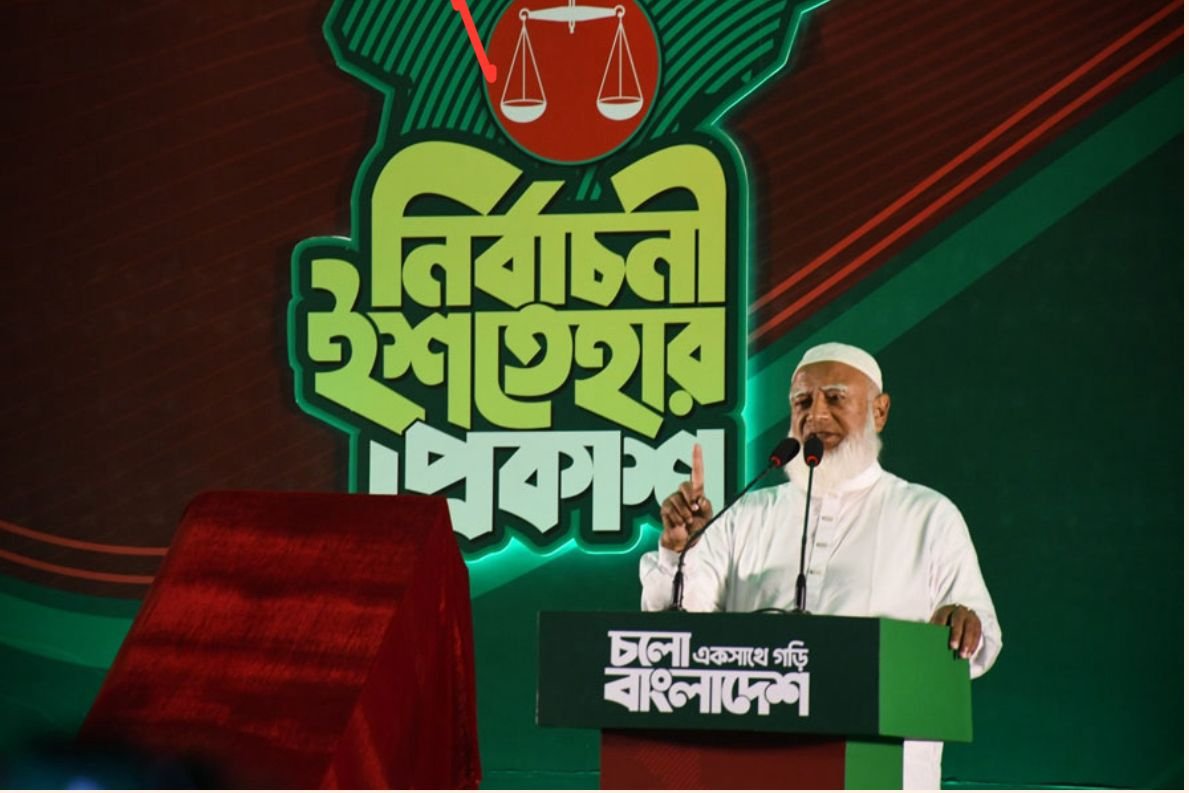
Jamaat-e-Islami may be accused of many things, but a lack of ambition is not one of them—at least not if its election manifesto is taken at face value. Spanning 36 pages and more than 14,000 words, the document reads less like a governing roadmap and more like an encyclopaedia of promises, gesturing towards a happily-ever-after Bangladesh while leaving the harder questions of feasibility and execution largely unanswered.
A substantial portion of the manifesto mirrors provisions and recommendations from the July Charter, which Jamaat had previously signed. Beyond that overlap, however, several pledges merit closer scrutiny. The document touches nearly every imaginable aspect of public life—from regulating freight truck movement in Dhaka between 11:00pm and 6:00am to the far more ambitious goal of expanding Bangladesh’s economy almost fourfold into a $2-trillion economy by 2040.
That prosperity, Jamaat suggests, will be driven by a sustained 7% annual GDP growth rate. The arithmetic, however, tells a different story. At that pace, Bangladesh would reach roughly $1.3 trillion by 2040. Achieving the $2-trillion mark would require near double-digit growth for at least 15 consecutive years—a feat that few economies in the world have managed, and none without massive structural transformation. The manifesto does not explain how this leap would be achieved.
This pattern repeats throughout the document. Whether discussing economic growth, education stipends, or expanded healthcare coverage, Jamaat offers little clarity on how such commitments would be delivered within a single five-year governing term. Targets are presented with a matter-of-fact certainty: $15 billion in foreign direct investment by 2030, Tk 10,000 loans for 100,000 meritorious students for up to five years, and a phased tripling of the health budget. These pledges are listed with the same level of detail as traffic regulations—ambitious, but thin on implementation.
Notably absent from the manifesto is any serious engagement with economic inequality, a defining challenge for Bangladesh. Instead, Jamaat layers promise upon promise: $5 billion in exports and two million ICT jobs by 2030, another five million jobs through government initiatives, 500 international-standard athletes in five years, 1.5 million freelancers through upazila-level e-hubs, and half a million new entrepreneurs within five years. The scale is impressive; the delivery mechanism is not.
While the manifesto stops short of explicitly pledging a theocratic state, it clearly elevates religious edicts in economic governance. Jamaat promises support for the expansion of Islamic banking and insurance, new laws to strengthen Islamic financial institutions, and shariah-compliant financing mechanisms in agriculture. These are not marginal reforms but structural shifts in financial policy, yet their broader economic implications remain unexplored.
Shariah principles are also set to play a stronger role in personal law and family courts, which Jamaat pledges to reform and preserve “in light of religion.” In education, the party proposes reorganising secondary schooling into four streams—Islamic, science, general, and technical—after class eight, alongside expanded funding and institutional support for Islamic scholarship.
The foreign policy section is revealing not only for what it includes, but for what it omits. Jamaat promises peaceful and cooperative relations with neighbouring and nearby countries—India, Bhutan, Nepal, Myanmar, Sri Lanka, Maldives, and Thailand—but makes no mention of Pakistan. This omission is immediately followed by a pledge to prioritise relations with the “Muslim world,” a juxtaposition that reads less like strategic clarity and more like a compensatory afterthought.
On labour and employment, Jamaat addresses the controversial five-hour workday that has repeatedly followed its leadership. The manifesto clarifies that reduced working hours would apply to women during maternity, and only with the mother’s consent. While this clarification may soften earlier remarks, it does little to dispel broader concerns about gender roles within the party.
Indeed, a striking contradiction emerges on women’s political representation. Jamaat leader Shafiqur Rahman has publicly stated that a woman could never lead the party due to Bangladesh’s “social reality.” Yet the manifesto pledges “significant representation” of women, ethnic minorities, and religious minorities in the cabinet. This promise sits uneasily with the fact that Jamaat has nominated no women and only one Hindu candidate in the current election.
The manifesto reiterates commitments to women’s safety, declaring that “women will move without fear.” The proposed measures—dedicated bus services, CCTV cameras, separate compartments on double-decker buses, and emergency helplines—suggest a tendency towards segregation framed as protection, rather than empowerment through equality. Alongside this are pledges for religious awareness campaigns to ensure women’s inheritance rights and VAT exemptions on children’s food products.
Finally, Jamaat’s treatment of the Liberation War demands attention. Given the party’s controversial role during 1971, its pledge to “firmly establish the ideals and objectives of the Great Liberation War—equality, human dignity, and social justice—within state and national life” warrants careful scrutiny. Another promise—that “the accurate history of the Liberation War will be presented to students”—implicitly suggests that existing narratives are flawed and may require revision under a Jamaat-led government.
Taken together, Jamaat’s manifesto is undeniably expansive and rhetorically ambitious. But ambition without arithmetic, and ideals without implementation, risk turning governance into wish-listing. For voters, the central question remains unanswered: not what Jamaat wants to achieve, but how it realistically plans to do so.