
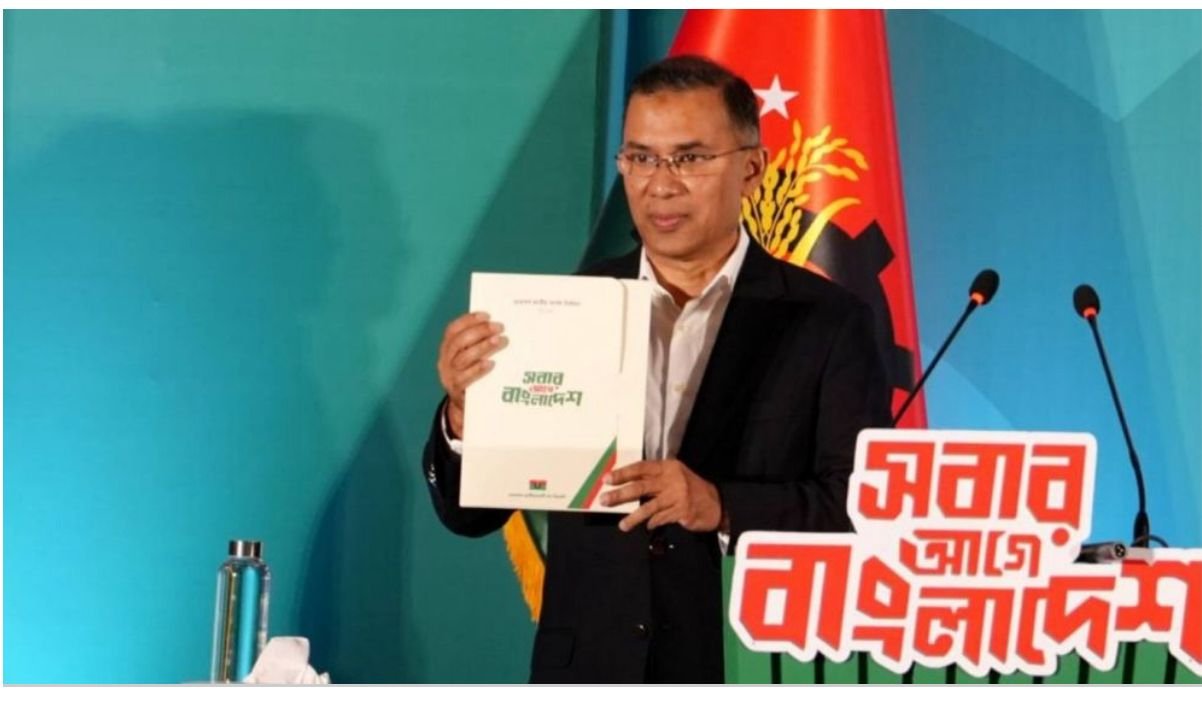
The Bangladesh Nationalist Party (BNP) on Thursday unveiled its election manifesto, pledging to transform Bangladesh into a modern, democratic, upper-middle-income country with a trillion-dollar GDP by 2034, while restoring what it called the “dignity of the vote” and ensuring that no one remains above the law.
The manifesto was formally launched by BNP Acting Chairman Tarique Rahman at a ceremony at the Sonargaon Hotel in Dhaka. The event, presided over by Secretary General Mirza Fakhrul Islam Alamgir, was attended by foreign diplomats, senior journalists, and members of civil society.
Framed around the slogan “Bangladesh Before All,” the manifesto outlines wide-ranging political, economic, and institutional reforms aimed at establishing an accountable and citizen-centric government.
With “complete faith in Almighty Allah” and inspired by the governance ideals of Prophet Hazrat Muhammad (PBUH), the BNP said justice (insaf) would be the guiding principle of the state. The party pledged to pursue governance based on fairness, humanity, and the rule of law.
Political and constitutional reforms
Key political pledges include the restoration of a neutral caretaker government during elections, constitutional and electoral reforms, and a ten-year cap on holding the office of prime minister, regardless of the number of terms served. The manifesto also allows a serving prime minister to simultaneously hold the position of party chief.
The BNP committed to strict anti-corruption measures and enhanced law-and-order enforcement, alongside the formation of an independent inquiry commission to investigate allegations of state terror, vote rigging, and corruption.
Economic vision and social protection
The party set an ambitious target to raise the tax-to-GDP ratio to 15% by 2035, up from less than 7% in the 2024-25 fiscal year, without increasing the tax burden on citizens.
Under its social protection agenda, the BNP pledged to introduce a “Family Card” providing Tk 2,500 per month in cash or essential commodities to low-income households. A “Farmer’s Card” will ensure fair crop prices, subsidies, affordable loans, insurance, and state-managed markets. Similar support schemes will be extended to fish farmers, livestock farmers, and small entrepreneurs.
Jobs, education, and healthcare
To tackle unemployment, especially among the youth, the BNP aims to create one million new jobs in the ICT sector, develop technical and language skills, support start-ups, integrate businesses with global e-commerce platforms, and ensure merit-based recruitment in government jobs.
Healthcare reforms include the recruitment of 100,000 health workers nationwide and upgrading medical services at district and metropolitan levels. In education, the party pledged a skills- and values-based curriculum, technology support for teachers and students, and the introduction of a midday meal programme in schools.
Infrastructure, energy, and environment
By 2030, BNP plans to raise power generation capacity to 35,000 megawatts and expand transmission lines to 25,000 circuit kilometres.
Environmental commitments include the excavation and re-excavation of 20,000 kilometres of rivers and canals, planting 250 million trees within five years, and implementing modern waste-management systems through public-private partnerships. A nationwide “Three R” (reduce, reuse, recycle) policy aims to cut plastic waste by 30% within five years.
Digital, creative economy and sports
The BNP pledged to expand the digital economy by introducing international payment systems such as PayPal, establishing regional e-commerce hubs, and boosting exports of “Made in Bangladesh” products.
In the creative economy, the party set a target of contributing 1.5% of GDP and creating 500,000 jobs by 2035, focusing on film, music, theatre, animation, VFX, gaming, and digital content creation.
Sports will be developed as a professional career path through expanded infrastructure and training facilities at district and upazila levels.
Foreign policy
On foreign relations, the BNP pledged to treat other nations as “friends, not masters,” prioritising sovereignty, national security, and the welfare of Bangladeshi citizens. Bilateral and multilateral ties, it said, would be based on equality, pragmatism, and mutual interest.
“This manifesto is not merely an electoral pledge; it is a declaration of a new social and state contract with the citizens of Bangladesh,” the document states, adding that BNP believes in “justice and humanity, not revenge.”
“If entrusted with responsibility by the people’s mandate, BNP will build a Bangladesh where the dignity of the vote is upheld, no one is above the law, and every citizen can proudly say — Bangladesh before all.”