
The son of Bangladesh’s ousted prime minister Sheikh Hasina has made a rare admission that her government “completely mishandled” the volatile protests led by Generation Z in 2024 — a movement that ultimately brought down the Awami League’s long-standing rule.
Speaking to The Independent, Sajeeb Wazed acknowledged serious failures in handling the youth-led uprising, describing both “a failure of communication and a failure of judgement.”
“Our government did not sit down with the protesters,” Wazed said. “And then you had Islamists taking advantage of the protests, militants jumping in… armed attacks… taking this as an opportunity to try and overthrow the government.”
He conceded that the state response was excessive.
“At that point, our government completely mishandled it. Law enforcement used excessive force. We let it get completely out of hand. It should never have gone that far. It’s regrettable.”
A Turbulent Election
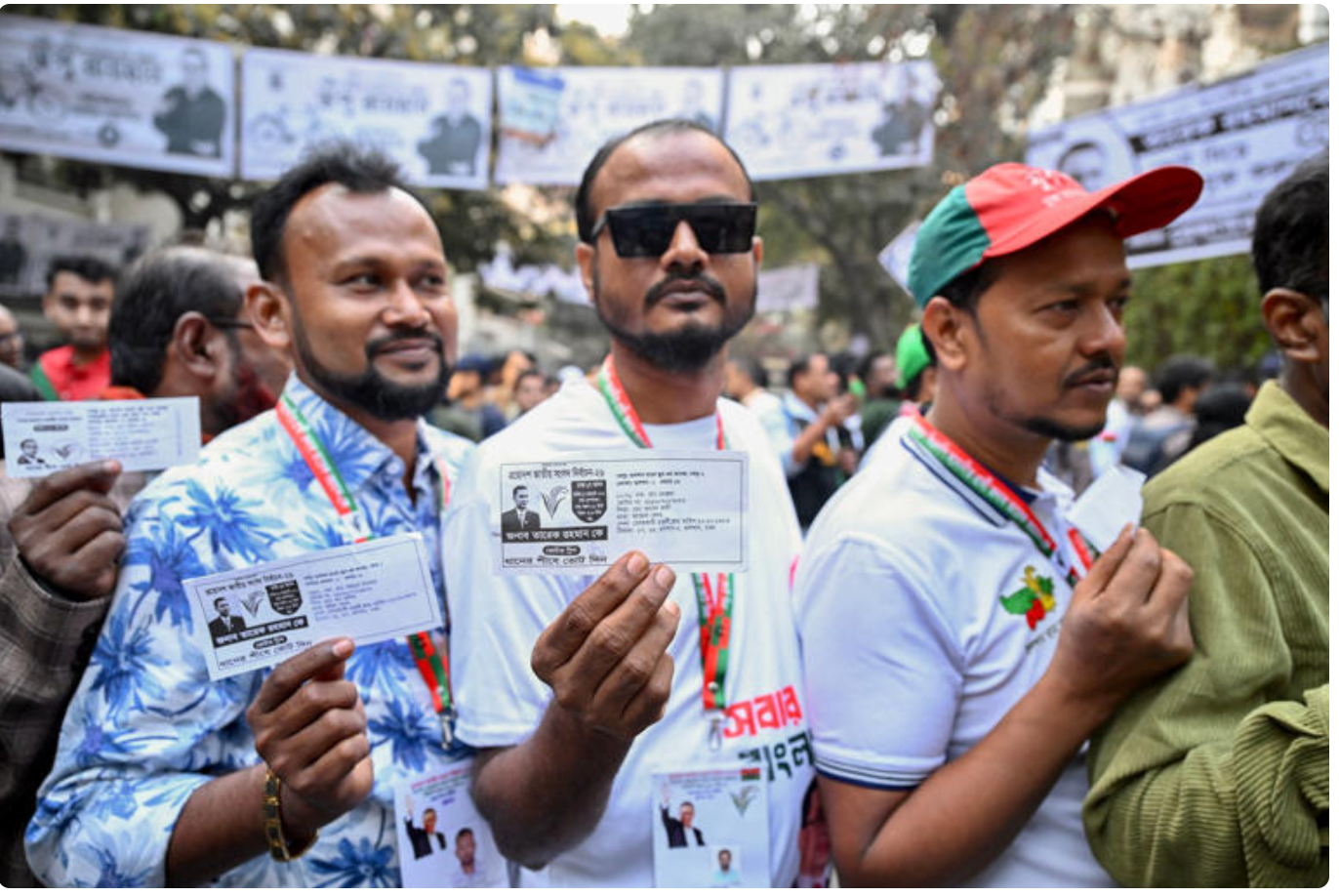
More than 128 million voters are set to cast their ballots on Thursday in what authorities describe as a vote to restore democratic governance after 18 months of political and economic turbulence.
However, Wazed — who is currently barred from contesting — has urged Awami League loyalists to boycott what he calls a “completely manipulated election.”
“This is designed in particular to give Jamaat-e-Islami a much greater proportion of seats in parliament than they would ever get in a fair election,” he alleged in a phone interview from Washington.
He further claimed that there is a de facto ban on “all progressive and non-Islamic parties” in Bangladesh.
The interim government, led by Nobel laureate Muhammad Yunus, has banned the Awami League from political activities, citing national security concerns and the need to protect witnesses in ongoing criminal trials.
Fallout from the Crackdown
A UN report estimated that up to 1,400 people were killed during the government’s crackdown on protesters. In November, a Bangladeshi tribunal sentenced Sheikh Hasina to death in absentia for crimes against humanity — an unprecedented ruling that drew sharp international criticism.
Hasina fled to India in mid-2024 after mass protests escalated into a nationwide uprising. She currently resides in New Delhi under full security protection.
According to Wazed, Hasina had met with families of victims and formed a judicial inquiry committee to investigate the violence — a body he claims was later dissolved by the Yunus administration.
“Yes, what happened is regrettable,” he said. “But what happened after is definitely not justice. It’s a mockery of justice.”
Internal Party Failures
While acknowledging the government’s errors, Wazed stopped short of blaming his mother directly, instead attributing responsibility to senior party officials.
“Because the party was in power for so long, you had people in key positions for far too long,” he said. “They became far too authoritarian. And people such as myself — we weren’t happy with it at all.”
He claimed he had advised leadership changes, but his recommendations were ignored.
“The whole party got blamed.”
Claims of Repression
Wazed alleges that since the uprising, more than 500 Awami League members have been killed and thousands arrested. He claimed that “Operation Devil Hunts” led to mass arrests of party activists and that tens of thousands of leaders remain detained without due process.
He also warned of rising influence by the once-outlawed Jamaat-e-Islami, expressing concern over what he described as the “Islamisation” of Bangladesh and targeted violence against minorities.
These claims have not been independently verified.
Legacy and Uncertain Return
Sheikh Hasina, Bangladesh’s longest-serving prime minister, is credited with overseeing rapid economic growth, a boom in garment exports, and a balancing act between India and China. However, her tenure was also marked by accusations of authoritarianism, suppression of dissent, and controversial elections.
Wazed insists the Awami League retains deep roots tied to Bangladesh’s independence history.
“It is not a matter of if but when about the Awami League’s return to active politics in Bangladesh,” he said.
With nearly a third of voters belonging to Generation Z — the very demographic that spearheaded the 2024 uprising — Wazed believes their anger will fade.
“Half of those youths regret what happened,” he claimed, citing youth polling, and arguing that economic decline and deteriorating law and order under the interim administration have shifted sentiment.
Hasina in Exile
According to Wazed, his mother is in “good health” in India and is being treated “as a head of state.”
“She is actually in the safest place in the world that she could be,” he said. “She is healthy and perfectly safe.”