
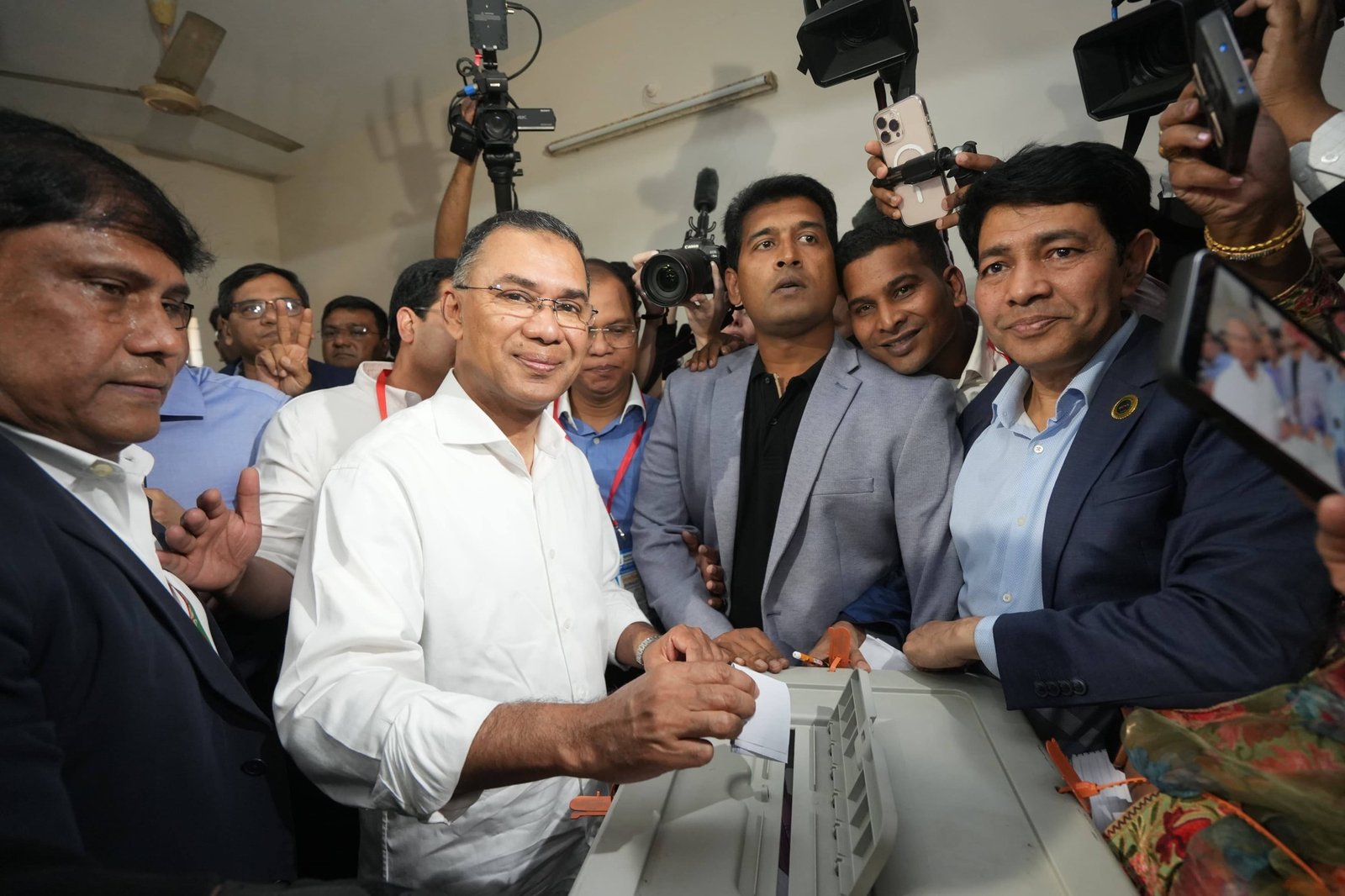
Jailed, exiled and now returned, BNP leader positions himself as frontrunner in landmark vote
Bangladesh began voting today in its first widely regarded free and competitive election in nearly two decades, with Bangladesh Nationalist Party (BNP) leader Tarique Rahman pledging a decisive break from what he described as years of institutionalised corruption.
Speaking ahead of polling, Rahman promised a “top-down zero-tolerance” policy toward graft if his party secures power. Opinion surveys suggest the BNP is likely to secure a significant majority, ahead of Jamaat-e-Islami and its Islamist allies.
Rahman, 60, described the election as taking place at a “critical and challenging” juncture for the country.
“Corruption became embedded under the previous administration,” he said. “Restoring accountability across every level of government will take time, but firm action and clear messaging can begin to rebuild trust.”
A Pivotal Vote After Political Upheaval
This election follows the dramatic fall of Sheikh Hasina in mid-2024 after a student-led uprising and subsequent state crackdown that, according to UN estimates, left approximately 1,400 people dead.
Hasina, now in exile in India, was later convicted in absentia of crimes against humanity linked to the final period of her administration.
Her Awami League government had overseen three consecutive elections widely criticised by opposition parties and international observers for irregularities and suppression of dissent. Thousands of BNP leaders and activists were detained during that period.
Since August 2024, an interim administration led by Nobel laureate Muhammad Yunus has overseen preparations for the vote, aiming to restore democratic credibility. Despite ongoing economic and security challenges, observers say a peaceful poll would mark a significant democratic reset.
More than 127 million voters are registered, with extensive security deployment nationwide.
Rahman’s Return After 17 Years
Rahman returned to Bangladesh in December 2025 after 17 years in London, where he had been living following his release from detention in 2008. He assumed leadership of the BNP from his mother, former prime minister Khaleda Zia, who passed away shortly after his return.
Though he held no formal government post during the BNP administration from 2001 to 2006, critics long alleged he exercised significant political influence during that period. Allegations of corruption and political interference have followed him for years, which he continues to reject.
His convictions under Hasina’s government were overturned after the 2024 political transition, clearing the way for his return.
“If there had been evidence, it would have stood the test of time,” Rahman said. “It has been nearly two decades.”
Rahman has acknowledged past governance shortcomings under BNP rule, stating that lessons have been learned and reforms are necessary.
Dynastic Politics and Islamist Resurgence
Rahman’s candidacy also revives debate over dynastic leadership in Bangladesh. With both his parents having served as prime minister, critics argue that the country risks continuing a political culture dominated by established families.
Meanwhile, Jamaat-e-Islami — previously restricted under Hasina — has re-emerged as a significant force and is expected to secure its strongest electoral performance to date. Its platform includes proposals aligned with greater Islamic legal influence in governance.
Human rights groups have recently expressed concern over incidents of moral policing and growing conservative activism in parts of the country.
Rahman dismissed suggestions that Islamist gains pose a systemic threat, arguing that economic opportunity and democratic participation would mitigate extremism.
“When people have jobs, stability and a voice, they move away from radicalism,” he said.
Recalibrating Relations with India
A future BNP government would also face the challenge of redefining Bangladesh’s relationship with India. Under Hasina, Dhaka maintained close ties with New Delhi. Relations have cooled significantly since her removal, particularly as India continues to host her in exile.
Rahman said any future engagement must be based on “mutual respect and understanding,” declining to elaborate on how tensions might be resolved while former Awami League figures remain in India.