
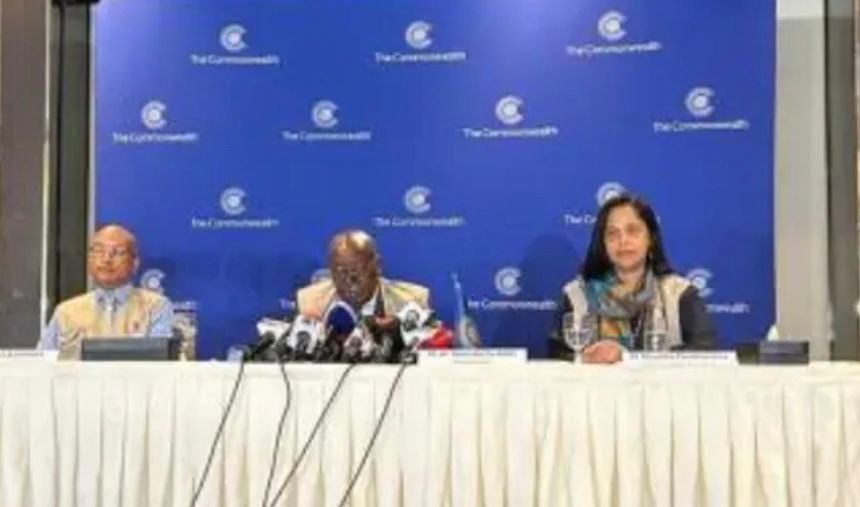
Interim Statement by
HE Mr Nana Addo Akufo-Addo
Former President of Ghana
Chairperson of the Commonwealth Observer Group
14 February 2026 | Dhaka, Bangladesh
INTRODUCTION
1. The people of Bangladesh, members of the media, fellow observers, members of the diplomatic corps, ladies and gentlemen; good afternoon to you all. Thank you for joining us at this Commonwealth Observer Group Press Conference.
2. I am honoured to chair the Commonwealth Observer Group for the 13th parliamentary elections and the referendum on the July Charter, at a watershed moment in Bangladesh’s history. Our presence here reaffirms the Commonwealth’s support to the people and Government of the People’s Republic of Bangladesh and its democratic process.
3. Let me at the outset commend the people of Bangladesh, the Bangladesh Election Commission including the election officials, law enforcement agencies, and the interim Govermment, for the peaceful and orderly manner in which the parliamentary elections and the referendum were conducted.
4. This Commonwealth Observer Group is an independent body that will make recommendations to the Commonwealth Secretary-General. Our mandate is to offer an informed and impartial assessment of the entire electoral process according to standards for democratic elections, as set out in the Declaration of Principles for International Election Observation, and in the 2018 Revised Guidelines on Commonwealth Election Observation.
5. The Commonwealth is honoured to have been invited by the Chief Election Commissioner of the Bangladesh Election Commission. I take this opportunity to express our appreciation to the interim Government of Bangladesh and the Bangladesh Election Commission for all the arrangements that have been made to facilitate the work of the Commonwealth Observer Group, which was constituted by the Commonwealth Secretary-General, the Honourable Shirley Botchwey. It comprises myself and twelve experts drawn from the fields of politics, law, media, gender, and election administration from several Commonwealth regions.
6. The Commonwealth Secretariat announced the deployment of the Group on 21 January 2026. We arrived in Dhaka on 4 February, having been preceded by a Commonwealth Secretariat staff team that has been in the country since 30 January.
7. The Group notes the long history of Commonwealth engagement with Bangladesh. The Commonwealth admitted Bangladesh as its 34th member on 18 April 1972, after its independence in December 1971. This is the fourth time that a Commonwealth Observer Group has been deployed.
BACKGROUND
8. I will now present the preliminary findings of the Group. The final report, setting out our full findings on the electoral process and our recommendations in greater detail, will be submitted to the Commonwealth Secretary-General and shared with the Government of Bangladesh, the Bangladesh Election Commission, and other key national stakeholders, and will be made publicly available to all.
9. On 10 February, we deployed in teams across the eight divisions of Bangladesh, in Barisal, Chattogram, Dhaka, Khulna, Mymensingh, Rajshahi, Rangpur and Sylhet, to observe pre-election activities and Election Day.
THE PRE-ELECTION ENVIRONMENT
Stakeholder engagement
10. Prior to our deployment, we met with a range of stakeholders in Dhaka, including Chief Adviser Professor Muhammad Yunus and other members of the interim Government of Bangladesh, the Chief Justice, the Chief Election Commissioner and other members of the Bangladesh Election Commission, the Chief of Army Staff, and Inspector-General of Police. We were also briefed by political parties, media representatives, online monitoring and fact-checking groups, civil society organisations including women and youth groups and representatives of persons with disabilities (PWDs), as well as Commonwealth High Commissioners and international organisations. In addition, we met with other international observer missions and local citizen observer groups.
Context of the elections
11. The electoral process took place against the backdrop of significant political developments following the July Uprising of 2024. Under the interim Government of Bangladesh, the political environment has been shaped by key decisions, including consultative dialogue on political reforms, which culminated in the July Charter and the associated referendum process, as well as decisions affecting the participation of some political parties, including the barring of the Awami League. It is within this transitional context that the elections and referendum were conducted.
Participation and Inclusion
Women
12. Women: We were encouraged by the number of women who turned out to exercise their franchise. However, these elections also showed that more needs to be done to encourage the inclusion of women, given the low percentage (4%) of women candidates and only seven women elected in these elections.
13. Accordingly, we will make recommendations to garner support for women’s increased participation in future electoral processes in Bangladesh. Our meetings with various stakeholders, including civil society and youth groups, indicated that there is room for improvement in fielding women in the election process due to the prevailing environment, including online harassment and bullying.
Youth
14. Youth: The Group acknowledges the increasingly visible role of youth in political mobilisation and public discourse, with many interlocutors pointing to heightened levels of political awareness and activism among younger citizens. At the same time, several stakeholders conveyed that this energy does not always translate into influence within formal party hierarchies or decision-making structures, thereby raising questions about whether youth participation is being institutionally embedded or remains largely consultative or episodic. We encourage the new Government to continue efforts towards greater youth participation and empowerment in governance.
Political participation
15. Political participation: Stakeholders conveyed to the Group differing perspectives on the breadth of political representation in Bangladesh, not just in these elections, but during other periods of her political history. The Commonwealth will continue to highlight its shared values in all member countries, to advocate for each voter to be enfranchised and a level playing field of all political parties, to enshrine democratic culture and support long-term political stability.
Referendum on July Charter
16. The proposed referendum on the July Charter featured prominently in discussions with stakeholders. The Group recognises the Charter as a response to multiple and urgent demands for reform. At the same time, some stakeholders expressed concerns about whether the referendum process was sufficiently consultative, and clearly communicated.
Security
17. The Group received consistent assurances from law enforcement and security agencies regarding their coordination to ensure a stable and enabling environment throughout the electoral period. We commend this coordination and the specific arrangements to ensure the safety for voters and all Bangladeshis. In addition, we express our appreciation to the security forces for facilitating the freedom of movement of citizen and international observers.
Postal Ballots
18. The extension of a postal ballot mechanism to out of country voters and inmates in this electoral cycle represents a laudable development to enfranchise a greater number of citizens. We recognise this step as a bold and positive measure towards greater inclusivity, while also supporting further efforts to enhance the efficacy, transparency, and public confidence in the logistics of its implementation.
Media
19. The Bangladeshi media is vibrant and active, and the Group commends it for the depth and breadth of its coverage of these elections. Broadcast, online and print media provided extensive reporting on a range of election-related issues and broader political developments, contributing to public engagement. This enhanced media freedom strengthened the quality of political discourse.
20. Although the Constitution guarantees press freedom, some stakeholders reported harassment, threats and violence, including arson attacks on the offices of Prothom Alo and The Daily Star, the biggest Bangla and English language newspapers. Despite these concerns, mainstream media played a dynamic role in reporting on a wide range of issues and competing positions of parties.
21. Stakeholders conveyed that social media was a major factor in shaping these elections. Social media platforms have been used to conduct campaigns and reach voters with minimal restrictions. While this has facilitated engagement, the proliferation of false information, hate speech, misogyny, and cyberbullying is of considerable concern. The emergence of AI-generated content poses a risk of misleading voters and distorting public debate.
22. In this context, the introduction of fact-checking columns by news organisations, along with fact-checking efforts by civil society, is commendable. We welcome further efforts to address the scale of digital threats and false information circulating online. We will, therefore, be recommending more proactive measures to address such concerns.
The Campaign
23. We note that the Bangladesh Election Commission introduced a Code of Conduct with clear guidelines on campaigning, social media use, political parties and candidates’ campaign materials, which were designed to ensure that the elections were conducted in a neutral, orderly and peaceful political environment. The Group notes that, aside from isolated incidents, the campaign environment was generally vibrant, festive, and well attended by party supporters. The Code of Conduct only allowed the use of portrait or party symbols on campaign materials in black and white, except for billboards, and we observed that – for the most part – this was largely respected.
ELECTION DAY
24. The Group noted a peaceful atmosphere prior to the opening of the polls.
Pre-Poll Procedures
25. In all instances observed by our Group, ballot materials were distributed to polling stations in advance of the opening of polls. Polling staff followed pre-poll procedures in accordance with prescribed guidelines.
Opening and Conduct of Poll
26. Polling stations opened on time. Opening procedures were implemented in a professional manner. Voting was conducted in a peaceful manner, with procedures largely followed. While a few isolated incidents were reported, these did not appear to affect the overall conduct of voting in a systemic manner.
27. In all polling stations visited, relevant information for voters in relation to the location of their voting stations was clearly displayed. We observed that polling stations had separate queues for men and women. Most polling stations were divided into two or more streams which aided queue management. Overall, the polling officials conducted their duties with professionalism and diligence.
Postal Ballot
28. The Group was able to observe postal ballot counting in some locations, and notes that prescribed procedures were followed.
Polling Agents
29. Polling agents were observed in all polling stations. In general, they conducted themselves professionally throughout the voting process.
Citizen and International Observers
30. Our observers interacted with the Alliance for Fair Election and Democracy (AFED), Asian Network for Free Elections (ANFREL), European Union (EU) observers, and others.
Secrecy of the Ballot
31. The layout at polling stations ensured the secrecy of the ballot. Most polling stations were at schools.
Participation and Inclusion
32. We note the participation of women as polling officials and security personnel, and commend the large numbers of women voters. However, we noted that Presiding Officers were predominately men, suggesting room for advancing women into senior electoral roles.
33. The Group observed that election and security officials assisted PWDs and the elderly to vote. However, polling stations in general were inaccessible to persons with physical challenges, especially on the upper floors, a situation that needs to be addressed. The Group also observed that there were no accommodations for other forms of disability. We will reflect on this issue and offer recommendations in our final report.
Security
34. We observed the presence of police and other security officials in all polling stations. They were professional, and enabled an orderly and peaceful atmosphere. We observed the introduction of CCTV at polling stations, and body cameras on security personnel. These measures enhanced security, without compromising the integrity of the process.
Close of Polls and Tabulation
35. At the close of polls at 4:30 PM, most polling stations we observed had no queues. We observed that polls generally closed on time and polling officials adhered to procedures. Our observers followed the results process, from polling stations to Returning Officers’ locations, in various constituencies. We observed the transparent nature of the count at polling stations, as well as the counting of postal ballots.
CONCLUSION AND POST-ELECTION PERIOD
36. While the Group has noted isolated reports of post-election tensions, we encourage all stakeholders to continue to promote calm and peaceful conduct during the post-election period, and to resolve any disputes through the relevant legal channels.
37. Looking ahead to the next election cycle, we encourage the Bangladesh Election Commission to conduct a post-election review, including of all observer recommendations, as is consistent with good practice. We urge it to consider establishing an appropriate domestic mechanism to implement recommendations of our final report. We also call on the Commonwealth Secretariat and other international partners to remain ready to support Bangladesh in this regard.
38. The people of Bangladesh have exercised their democratic rights to seek the fulfilment of their aspirations. We encourage them to be magnanimous and united in their shared democratic future.